

Category Archives: Australia

Categories Australia

Work limitation on Working Holiday visas

Employers frequently ask us to confirm the circumstances in which holders of Working Holiday visas may work beyond 6 months, as per their visa conditions.

If the employer has more than one location of work and offers employment in a different location, this will enable the employer to employ the Working Holiday maker for an additional six months at the new location. It is also possible to move the employee between different arms of the business if the employee will work for a different branch or franchise.

Otherwise, depending on the occupation and the skills of the Working Holiday maker, the employer may be able to sponsor the employee for a TSS visa for 2 or 4 years. If the employer would like to retain the Working Holiday maker on an ongoing basis, the best time to initiate the TSS process is three months into the work assignment (to allow enough time to prepare for the TSS visa and minimise any gaps in employment).

If the Working Holiday visa expires while the TSS application is being processed, the employee may work for the employer for an additional (new) six month period once their bridging visa comes into effect. The employee may work for another six months each time a new bridging visa is granted.

Unless a new visa application has been lodged, the circumstances of being able to work beyond 6 months are very limited, including:

  • The new employment will be in a specified regional area (defined by post code but excluding all of Sydney) and the new employment relates to specified occupations in specified industries e.g. aged care, tourism and hospitality, agriculture, fishing, forestry;
  • The person is critical to the completion of a specialised project that has unexpectedly gone over time. The threshold for this is extremely high and detailed evidence would need to be shown that no one else can do this job. In any case, in this situation, the extension of work rights will only be approved for days or weeks;
  • If the person is getting workers compensation payments as a result of a workplace injury;
  • The person needs to work in disaster recovery work following a declared major disaster; or
  • The workplace has been affected by a major disaster and the person was unable to physically go to work.

You are welcome to discuss specific situations with your Ajuria Lawyers advisor.

DISCLAIMER This information is current as of 31 July 2019 and subject to change. The information contained in this publication is of a general nature only. It should not be used as legal advice. To the extent permissible by law, Ajuria Lawyers and its associated entities shall not be liable for any errors, omissions, defects or misrepresentations in the information or for any loss or damage suffered by persons who use or rely on such information. Liability limited by a scheme approved under Professional Standards Legislation.
Categories Australia

Collection and Use of Biometrics

We expect to see an increase in the number of requests by the Department of Home Affairs for ‘personal identifiers’ as part of the process for all visa types including TSS visas.

Personal identifiers can include:

  • fingerprints;
  • measurements of the person’s height and weight;
  • photograph or other image of the person’s face and shoulders;
  • audio or a video recording of the person’s voice; and
  • iris scans.

Collection of personal identifiers must occur at an approved centre and these are sometimes limited to major cities in specific countries.

Currently, personal identifiers are requested in a limited number of situations based on the applicant’s nationality or place of residence. However, legislation has been passed to broaden the circumstances in which personal identifiers will be requested and to make this a pre-condition of lodging a valid application.

This matters to employers because a request for biometrics can mean additional processing times and cost for employees. We will advise your employee early in the process if we believe a request is likely but, as it is often discretionary, we may only know once it is requested by the Department.


DISCLAIMER This information is current as of 31 July 2019 and subject to change. The information contained in this publication is of a general nature only. It should not be used as legal advice. To the extent permissible by law, Ajuria Lawyers and its associated entities shall not be liable for any errors, omissions, defects or misrepresentations in the information or for any loss or damage suffered by persons who use or rely on such information. Liability limited by a scheme approved under Professional Standards Legislation.

Categories Australia

No change in TSMIT

It has been a long time since there was a change in the Temporary Skilled Migration Income Threshold, known as the TSMIT. In fact, the current TSMIT of $53,900 was set in 2013.

Prior to the election, there was some discussion about TSMIT and the need for it to be reviewed in line with wages. The Labor Party was particularly outspoken about the need to increase the TSMIT to at least $65,000.

The beginning of a new financial/immigration year is often the time that such changes are made, however there was no change to the TSMIT on 1 July 2019.

There was also no new list of occupations for TSS visas.

The only change was an increase in the Fair Work High Income Threshold (FWHIT) to $148,700. This is relevant to certain applicants for Employer Nomination 186 visa (PR) and their ability to meet the age exemptions, as well as applicants under the Global Talent Scheme.

DISCLAIMER This information is current as of 31 July 2019 and subject to change. The information contained in this publication is of a general nature only. It should not be used as legal advice. To the extent permissible by law, Ajuria Lawyers and its associated entities shall not be liable for any errors, omissions, defects or misrepresentations in the information or for any loss or damage suffered by persons who use or rely on such information. Liability limited by a scheme approved under Professional Standards Legislation.

Categories Australia

New report on Temporary Migration

CEDA, the Centre for Economic Development in Australia, has recently released an interesting report on “Effects of Temporary Migration”.

Holders of TSS visas, students, working holiday makers and New Zealand citizens make up almost 2 million temporary migrants currently in Australia. Those of working age account for less than 1% of Australia’s labour force of 13.5 million.

The report identified the following characteristics of temporary migrants:

  • More than half work in four industries: accommodation and food services; information, media and telecommunications; professional, scientific and technical services; other services (personal care and mechanical repairs);
  • The top four occupations based on visa grant were Developer Programmer, ICT Business Analyst, University Lecturer, Cook;
  • The average base salary is $95,000 (based on 2017-18 data);
  • The top three citizenships of visa holders (excluding New Zealand) are United Kingdom, India and the Philippines;
  • 96% are under the age of 50 years (compared with 67% of the Australian population).

The report found that there was no evidence that temporary skilled migrants displace local workers and undercut local terms and conditions – despite ongoing suggestions to the contrary.

Anyone interested in the history of temporary migration in Australia, and recommendations as to how the current program could be improved, is encouraged to read the CEDA report here.

DISCLAIMER This information is current as of 31 July 2019 and subject to change. The information contained in this publication is of a general nature only. It should not be used as legal advice. To the extent permissible by law, Ajuria Lawyers and its associated entities shall not be liable for any errors, omissions, defects or misrepresentations in the information or for any loss or damage suffered by persons who use or rely on such information. Liability limited by a scheme approved under Professional Standards Legislation.

Categories Australia

Government Application Fees

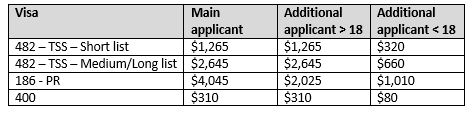
In the Government’s pre-election Budget, the Treasurer announced an increase in Government application fees for all visa subclasses, except the Visitor Subclass 600.

The increase will be 5.4%, effective from 1 July 2019.

This fee increase is expected to generate additional revenue of $275 million by 2021-2022:

No increases to the Training Levy.

DISCLAIMER This information is current as of 1 July 2019 and subject to change. The information contained in this publication is of a general nature only. It should not be used as legal advice. To the extent permissible by law, Ajuria Lawyers and its associated entities shall not be liable for any errors, omissions, defects or misrepresentations in the information or for any loss or damage suffered by persons who use or rely on such information. Liability limited by a scheme approved under Professional Standards Legislation.

Categories Australia

Changes to the Working Holiday Program

Some changes came into effect on 1 July 2019 relating to the Working Holiday Program:

  • France – French nationals up to the age of 35 years are now eligible for Working Holiday Visas for Australia. France joins Ireland and Canada as countries that have signed up to this arrangement. All other countries part of the program have a cut off age of 31.
  • Greece and Ecuador have been added to the list of countries whose citizens may be eligible to apply for the Work and Holiday visa.
  • Citizens of Austria, Portugal and Spain no longer need to provide evidence of government support for their application.
  • Citizens of Indonesia, Singapore, Thailand, Turkey and Vietnam can now make electronic applications.

DISCLAIMER This information is current as of 1 July 2019 and subject to change. The information contained in this publication is of a general nature only. It should not be used as legal advice. To the extent permissible by law, Ajuria Lawyers and its associated entities shall not be liable for any errors, omissions, defects or misrepresentations in the information or for any loss or damage suffered by persons who use or rely on such information. Liability limited by a scheme approved under Professional Standards Legislation.

Categories Australia

Meanwhile in New Zealand

New Zealand has its own immigration system comprised of various rules and requirements for those wishing to travel to and stay in New Zealand.

Currently, Australian citizens travelling on Australian passports, and those who hold Australian permanent resident visas with valid Resident Return Visas, can travel to New Zealand and be granted residence visas on arrival. People travelling on non-Australian passports, including Australian citizens with dual nationality, must apply for and be granted a visa to be permitted to enter and remain in New Zealand for a specific purpose.

From 1 July 2019 (and compulsory from 01 October 2019), all passport holders will require an NZeTA prior to travel, with the exception of Australian citizens (travelling on an Australian passport) or those who are already holding a valid visa for New Zealand.

This is a significant change for Australian permanent resident visa holders, who will still have the right to reside permanently and unconditionally in New Zealand, however will have to apply for an NZeTA prior to travel. This has been introduced by the New Zealand Government as an additional form of security checking.

Some interesting facts and figures about New Zealand immigration that you may not have known….

·         1 in 4 people in New Zealand were born overseas;

·         New Zealand comes in second only to Ireland in terms of the number of citizens (relative to overall population) who are residing outside of New Zealand;

·         New Zealand has the largest temporary labour migration flows in the OECD, relative to population size.

Our adviser in New Zealand, Karen Justice, is happy to assist with any New Zealand visa query.

DISCLAIMER This information is current as of 27 June 2019 and subject to change. The information contained in this publication is of a general nature only. It should not be used as legal advice. To the extent permissible by law, Ajuria Lawyers and its associated entities shall not be liable for any errors, omissions, defects or misrepresentations in the information or for any loss or damage suffered by persons who use or rely on such information. Liability limited by a scheme approved under Professional Standards Legislation.

Categories Australia

Application Statistics

The Migration Institute of Australia has shared with its members some interesting statistics that paint a picture of the demand for and interest in Australia’s migration program.

Currently, the Department of Home Affairs is processing 30,000 applications under the Employer Nomination Scheme (Employer sponsored permanent residence). The number of available places in the 2019/20 Migration Program is 30,000.

In the Partner visa category, the numbers under processing are even more impressive (!):

Under Stage 1 Partner visa (Temporary)                82,000

Under Stage 2 Partner visa (Permanent)                156,000

Ready for Stage 2                                                        35,000

The number of places for Partner visas in the 2019/20 Migration Program is 39,799.

In relation to temporary visas, the Department is currently processing the remaining backlog of Subclass 457 visa applications (700-800 applications, many with health or character issues).

DISCLAIMER This information is current as of 27 June 2019 and subject to change. The information contained in this publication is of a general nature only. It should not be used as legal advice. To the extent permissible by law, Ajuria Lawyers and its associated entities shall not be liable for any errors, omissions, defects or misrepresentations in the information or for any loss or damage suffered by persons who use or rely on such information. Liability limited by a scheme approved under Professional Standards Legislation.

Categories Australia

Significant Investor Visa Impact

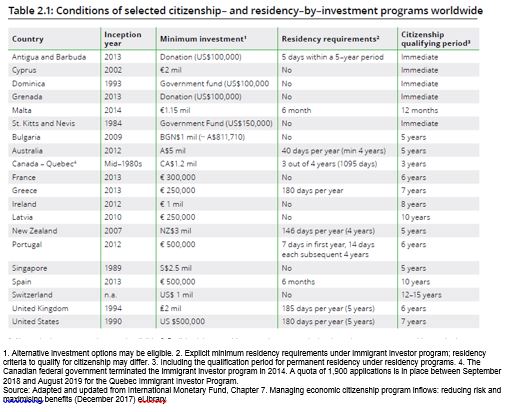
Given our focus on servicing employers’ visa requirements, Ajuria Lawyers does not often reference the Significant Investor Visa in our newsletters. However, a recent report of Deloitte Access Economics (2019) on the impact of this visa program, has highlighted that from the commencement of the program in November 2012 to June 2018, 2022 visas have been granted and $10.1 billion has been invested into complying investments in Australia.

Many countries have their own version of the Significant Investor Visa program. In Australia, the program provides a 4 year visa with a pathway to permanent residence for high net worth individuals who inject at least $5 million into complying investments.

As shown in the table below, different countries have different residency and citizenship incentives to overseas investors, with some countries offering citizenship immediately.

DISCLAIMER This information is current as of 27 June 2019 and subject to change. The information contained in this publication is of a general nature only. It should not be used as legal advice. To the extent permissible by law, Ajuria Lawyers and its associated entities shall not be liable for any errors, omissions, defects or misrepresentations in the information or for any loss or damage suffered by persons who use or rely on such information. Liability limited by a scheme approved under Professional Standards Legislation.

Categories Australia

Citizenship Update

There have been conflicting messages in recent weeks as to whether the newly-elected Morrison Government will move forward with changes to Australian Citizenship requirements, proposed in April 2017. These changes would have resulted in stricter English language testing and required the signing of an “Australian values” statement, as well as increasing the residential requirement for permanent residents from one to four years.

In the meantime, the Government has allocated $9 million to recruit and train additional staff to process the 222,800 citizenship applications in the pipeline. Between 1 July 2018 and 31 May 2019, 132,000 conferral applications were finalised, up from 70,000 in the same period last year.

DISCLAIMER This information is current as of 27 June 2019 and subject to change. The information contained in this publication is of a general nature only. It should not be used as legal advice. To the extent permissible by law, Ajuria Lawyers and its associated entities shall not be liable for any errors, omissions, defects or misrepresentations in the information or for any loss or damage suffered by persons who use or rely on such information. Liability limited by a scheme approved under Professional Standards Legislation.