Category Archives: Australia

Categories Australia

Global Talent Scheme to continue for employers

On 8 August 2019, the Hon David Coleman MP, Minister for Immigration, Citizenship, Migrant Services and Multicultural Affairs, announced the continuation of the pilot Global Talent Scheme.

Re-named the Global Talent Employer Sponsored (GTES) program, the pilot program ran for 12 months to 1 July 2019; the decision to continue followed a review.

The Minister announced that the program had received strong support from industry, and had been successful in attracting the best and the brightest to fill roles in the new economy.

This is despite only 23 businesses having signed five year agreements with the Government, and up to 30 visas having been approved during the pilot program.

In its reporting, the Australian Financial Review noted that there had been some criticism of the requirement to contribute to the Skilling Australians Fund, however the Government has confirmed that there is no intention to relax requirements.

For clients, the GTES remains another option to secure global talent, where business requirements are not adequately met under standard TSS and Employer Nomination (permanent) visa programs.

DISCLAIMER This information is current as of 27 August 2019 and subject to change. The information contained in this publication is of a general nature only. It should not be used as legal advice. To the extent permissible by law, Ajuria Lawyers and its associated entities shall not be liable for any errors, omissions, defects or misrepresentations in the information or for any loss or damage suffered by persons who use or rely on such information. Liability limited by a scheme approved under Professional Standards Legislation.


Categories Australia

Highly specialised work on 400 visa

There has been an important change to the policy guidelines relating to 400 visas applied for under the Highly Specialised Work stream (the most commonly used stream for a 400 visa).

This stream is designed to facilitate the entry of overseas workers to undertake work that is highly specialised and non-ongoing – likely to be completed within 3 months or less although in some cases up to 6 months can be obtained. This covers workers with highly specialised skills, knowledge or experience that can assist Australian businesses and cannot reasonably be found in the Australian labour market.

The new recently released policy clarifies work that is considered to satisfy the requirement for a 400 visa and the type of evidence that may be required to prove that the skills cannot be found in the Australian labour market.

1. Highly specialised skills relating to overseas technology

Where the applicant is employed by, or has been trained in relation to goods or services developed by, an overseas company that are being introduced to (or are already in use in) Australia the delegate should be satisfied that this specific (proprietary) knowledge is not available in the Australian workforce, or is of limited availability.

Some examples of these cases include:

  • an installer or maintainer of recently imported equipment, which requires specific knowledge to install or maintain;
  • a skilled mining engineer advising on a particular procedure or product which is not in use in Australia;
  • a training professional seeking to enter Australia to support the introduction of new products (for example, newly developed software), concepts or methods (for example, innovative business management techniques) to the Australian workplace or the opening of an international business in Australia; and
  • an internal auditor of an international company who may be required to audit an Australian subsidiary against company-specific control standards.

2. Highly specialised and not reasonably available in Australia

The applicant has highly specialised skills that can be found in Australia, but the skill set in the Australian community is extremely limited so as not to be practicably available to the Australian employer.

This generally means that Australian workers with the applicable skill set are already in employment and are not available. The overseas contractor /Australian business will need to satisfy the delegate that efforts have been made to contract available workers in Australia.

3. Other highly specialised skills

The 400 visa is not intended for workers seeking to perform a role that is generic to their profession. Examples of the sort of circumstances that should prompt further enquiry by a delegate are:

  • a team of tradespersons being brought to Australia to perform annual shutdown maintenance in an Australian factory;
  • a computer programmer being brought to Australia to assist a company to manage tight deadlines or peak workloads; or
  • an electrician being brought to Australia to install electrical wiring in a new housing development.

In these cases the level of evidence required to support the application will vary, depending on the proposed work and the risk profile of the applicant.

A statement by the prospective employer may be adequate evidence, but it is very likely that additional evidence may be required to demonstrate that the skills are not available. This could include evidence of labour market testing or statement from a large reputable employment agency, or assessment by a relevant peak industry body or comment from a relevant union – that the employment skills cannot be found within Australia.

Ajuria Lawyers will advise you of what may be needed for any given application.

DISCLAIMER This information is current as of 31 July 2019 and subject to change. The information contained in this publication is of a general nature only. It should not be used as legal advice. To the extent permissible by law, Ajuria Lawyers and its associated entities shall not be liable for any errors, omissions, defects or misrepresentations in the information or for any loss or damage suffered by persons who use or rely on such information. Liability limited by a scheme approved under Professional Standards Legislation.
Categories Australia

Illegal workers Implication for employers

Businesses found to employ workers illegally can face:

  • Infringement notices of up to $18,900 per offence;
  • Penalties of up to $94,500 per offence if the Department decides to undertake civil penalty proceedings in a court; and/or
  • Suspension or cancellation of sponsorship rights.

In the worst cases, individuals and companies can even face criminal prosecution with maximum penalties of imprisonment and fines of up to $126,000 per offence.

“Illegal workers” include:

  • Workers without a visa;
  • Workers that have a visa but do not have the relevant permission to work in Australia (for example, TSS visa holder working for new employer while still sponsored by their previous employer); or
  • Workers that have a visa that allows employment but it is limited (for example, students working beyond their permitted hours).

Even if civil or criminal sanctions are not pursued, employing an illegal worker can affect the ability of a company to sponsor workers. Something as simple as an ‘Illegal Worker Warning Notice’ may later be considered adverse information and can lead to rejection of future sponsorship applications.

It is important to know that the Department can monitor a business at any time. This may be formal monitoring request or an unannounced visit.

Employers must therefore be vigilant in checking work rights of all employees. Some of the steps employers can take include:

  • Requesting all new hires to provide evidence of their Australian citizenship/permanent residence/visa status;
  • Using the Department’s Visa Entitlement Verification Online (VEVO) checks. VEVO allows an employer to check if a foreign worker has a visa with the relevant permission to work;
  • Ensuring compliance with sponsorship obligations at all times in relation to sponsored workers;
  • Ensuring care is taken if hiring workers through on-hire arrangements. Do not assume the labour hire company has taken steps to ensure the worker has the relevant permission to work. Best practice is to also request evidence of their visa status and associated visa conditions;
  • Maintaining a record of the checks made. This will be helpful in the event of any future audit or monitoring.

Please contact your advisor if your organisation requires assistance with registering for VEVO checks, or if you have any query.

DISCLAIMER This information is current as of 31 July 2019 and subject to change. The information contained in this publication is of a general nature only. It should not be used as legal advice. To the extent permissible by law, Ajuria Lawyers and its associated entities shall not be liable for any errors, omissions, defects or misrepresentations in the information or for any loss or damage suffered by persons who use or rely on such information. Liability limited by a scheme approved under Professional Standards Legislation.

Categories Australia

Work limitation on Working Holiday visas

Employers frequently ask us to confirm the circumstances in which holders of Working Holiday visas may work beyond 6 months, as per their visa conditions.

If the employer has more than one location of work and offers employment in a different location, this will enable the employer to employ the Working Holiday maker for an additional six months at the new location. It is also possible to move the employee between different arms of the business if the employee will work for a different branch or franchise.

Otherwise, depending on the occupation and the skills of the Working Holiday maker, the employer may be able to sponsor the employee for a TSS visa for 2 or 4 years. If the employer would like to retain the Working Holiday maker on an ongoing basis, the best time to initiate the TSS process is three months into the work assignment (to allow enough time to prepare for the TSS visa and minimise any gaps in employment).

If the Working Holiday visa expires while the TSS application is being processed, the employee may work for the employer for an additional (new) six month period once their bridging visa comes into effect. The employee may work for another six months each time a new bridging visa is granted.

Unless a new visa application has been lodged, the circumstances of being able to work beyond 6 months are very limited, including:

  • The new employment will be in a specified regional area (defined by post code but excluding all of Sydney) and the new employment relates to specified occupations in specified industries e.g. aged care, tourism and hospitality, agriculture, fishing, forestry;
  • The person is critical to the completion of a specialised project that has unexpectedly gone over time. The threshold for this is extremely high and detailed evidence would need to be shown that no one else can do this job. In any case, in this situation, the extension of work rights will only be approved for days or weeks;
  • If the person is getting workers compensation payments as a result of a workplace injury;
  • The person needs to work in disaster recovery work following a declared major disaster; or
  • The workplace has been affected by a major disaster and the person was unable to physically go to work.

You are welcome to discuss specific situations with your Ajuria Lawyers advisor.

DISCLAIMER This information is current as of 31 July 2019 and subject to change. The information contained in this publication is of a general nature only. It should not be used as legal advice. To the extent permissible by law, Ajuria Lawyers and its associated entities shall not be liable for any errors, omissions, defects or misrepresentations in the information or for any loss or damage suffered by persons who use or rely on such information. Liability limited by a scheme approved under Professional Standards Legislation.

Categories Australia

Collection and Use of Biometrics

We expect to see an increase in the number of requests by the Department of Home Affairs for ‘personal identifiers’ as part of the process for all visa types including TSS visas.

Personal identifiers can include:

  • fingerprints;
  • measurements of the person’s height and weight;
  • photograph or other image of the person’s face and shoulders;
  • audio or a video recording of the person’s voice; and
  • iris scans.

Collection of personal identifiers must occur at an approved centre and these are sometimes limited to major cities in specific countries.

Currently, personal identifiers are requested in a limited number of situations based on the applicant’s nationality or place of residence. However, legislation has been passed to broaden the circumstances in which personal identifiers will be requested and to make this a pre-condition of lodging a valid application.

This matters to employers because a request for biometrics can mean additional processing times and cost for employees. We will advise your employee early in the process if we believe a request is likely but, as it is often discretionary, we may only know once it is requested by the Department.


DISCLAIMER This information is current as of 31 July 2019 and subject to change. The information contained in this publication is of a general nature only. It should not be used as legal advice. To the extent permissible by law, Ajuria Lawyers and its associated entities shall not be liable for any errors, omissions, defects or misrepresentations in the information or for any loss or damage suffered by persons who use or rely on such information. Liability limited by a scheme approved under Professional Standards Legislation.

Categories Australia

No change in TSMIT

It has been a long time since there was a change in the Temporary Skilled Migration Income Threshold, known as the TSMIT. In fact, the current TSMIT of $53,900 was set in 2013.

Prior to the election, there was some discussion about TSMIT and the need for it to be reviewed in line with wages. The Labor Party was particularly outspoken about the need to increase the TSMIT to at least $65,000.

The beginning of a new financial/immigration year is often the time that such changes are made, however there was no change to the TSMIT on 1 July 2019.

There was also no new list of occupations for TSS visas.

The only change was an increase in the Fair Work High Income Threshold (FWHIT) to $148,700. This is relevant to certain applicants for Employer Nomination 186 visa (PR) and their ability to meet the age exemptions, as well as applicants under the Global Talent Scheme.

DISCLAIMER This information is current as of 31 July 2019 and subject to change. The information contained in this publication is of a general nature only. It should not be used as legal advice. To the extent permissible by law, Ajuria Lawyers and its associated entities shall not be liable for any errors, omissions, defects or misrepresentations in the information or for any loss or damage suffered by persons who use or rely on such information. Liability limited by a scheme approved under Professional Standards Legislation.

Categories Australia

New report on Temporary Migration

CEDA, the Centre for Economic Development in Australia, has recently released an interesting report on “Effects of Temporary Migration”.

Holders of TSS visas, students, working holiday makers and New Zealand citizens make up almost 2 million temporary migrants currently in Australia. Those of working age account for less than 1% of Australia’s labour force of 13.5 million.

The report identified the following characteristics of temporary migrants:

  • More than half work in four industries: accommodation and food services; information, media and telecommunications; professional, scientific and technical services; other services (personal care and mechanical repairs);
  • The top four occupations based on visa grant were Developer Programmer, ICT Business Analyst, University Lecturer, Cook;
  • The average base salary is $95,000 (based on 2017-18 data);
  • The top three citizenships of visa holders (excluding New Zealand) are United Kingdom, India and the Philippines;
  • 96% are under the age of 50 years (compared with 67% of the Australian population).

The report found that there was no evidence that temporary skilled migrants displace local workers and undercut local terms and conditions – despite ongoing suggestions to the contrary.

Anyone interested in the history of temporary migration in Australia, and recommendations as to how the current program could be improved, is encouraged to read the CEDA report here.

DISCLAIMER This information is current as of 31 July 2019 and subject to change. The information contained in this publication is of a general nature only. It should not be used as legal advice. To the extent permissible by law, Ajuria Lawyers and its associated entities shall not be liable for any errors, omissions, defects or misrepresentations in the information or for any loss or damage suffered by persons who use or rely on such information. Liability limited by a scheme approved under Professional Standards Legislation.

Categories Australia

Government Application Fees

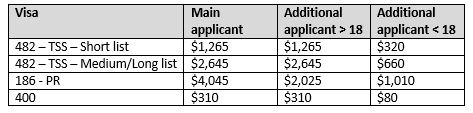
In the Government’s pre-election Budget, the Treasurer announced an increase in Government application fees for all visa subclasses, except the Visitor Subclass 600.

The increase will be 5.4%, effective from 1 July 2019.

This fee increase is expected to generate additional revenue of $275 million by 2021-2022:

No increases to the Training Levy.

DISCLAIMER This information is current as of 1 July 2019 and subject to change. The information contained in this publication is of a general nature only. It should not be used as legal advice. To the extent permissible by law, Ajuria Lawyers and its associated entities shall not be liable for any errors, omissions, defects or misrepresentations in the information or for any loss or damage suffered by persons who use or rely on such information. Liability limited by a scheme approved under Professional Standards Legislation.

Categories Australia

Changes to the Working Holiday Program

Some changes came into effect on 1 July 2019 relating to the Working Holiday Program:

  • France – French nationals up to the age of 35 years are now eligible for Working Holiday Visas for Australia. France joins Ireland and Canada as countries that have signed up to this arrangement. All other countries part of the program have a cut off age of 31.
  • Greece and Ecuador have been added to the list of countries whose citizens may be eligible to apply for the Work and Holiday visa.
  • Citizens of Austria, Portugal and Spain no longer need to provide evidence of government support for their application.
  • Citizens of Indonesia, Singapore, Thailand, Turkey and Vietnam can now make electronic applications.

DISCLAIMER This information is current as of 1 July 2019 and subject to change. The information contained in this publication is of a general nature only. It should not be used as legal advice. To the extent permissible by law, Ajuria Lawyers and its associated entities shall not be liable for any errors, omissions, defects or misrepresentations in the information or for any loss or damage suffered by persons who use or rely on such information. Liability limited by a scheme approved under Professional Standards Legislation.

Categories Australia

Meanwhile in New Zealand

New Zealand has its own immigration system comprised of various rules and requirements for those wishing to travel to and stay in New Zealand.

Currently, Australian citizens travelling on Australian passports, and those who hold Australian permanent resident visas with valid Resident Return Visas, can travel to New Zealand and be granted residence visas on arrival. People travelling on non-Australian passports, including Australian citizens with dual nationality, must apply for and be granted a visa to be permitted to enter and remain in New Zealand for a specific purpose.

From 1 July 2019 (and compulsory from 01 October 2019), all passport holders will require an NZeTA prior to travel, with the exception of Australian citizens (travelling on an Australian passport) or those who are already holding a valid visa for New Zealand.

This is a significant change for Australian permanent resident visa holders, who will still have the right to reside permanently and unconditionally in New Zealand, however will have to apply for an NZeTA prior to travel. This has been introduced by the New Zealand Government as an additional form of security checking.

Some interesting facts and figures about New Zealand immigration that you may not have known….

·         1 in 4 people in New Zealand were born overseas;

·         New Zealand comes in second only to Ireland in terms of the number of citizens (relative to overall population) who are residing outside of New Zealand;

·         New Zealand has the largest temporary labour migration flows in the OECD, relative to population size.

Our adviser in New Zealand, Karen Justice, is happy to assist with any New Zealand visa query.

DISCLAIMER This information is current as of 27 June 2019 and subject to change. The information contained in this publication is of a general nature only. It should not be used as legal advice. To the extent permissible by law, Ajuria Lawyers and its associated entities shall not be liable for any errors, omissions, defects or misrepresentations in the information or for any loss or damage suffered by persons who use or rely on such information. Liability limited by a scheme approved under Professional Standards Legislation.