

Category Archives: Australia

Categories Australia

National Innovation Visa – NSW and South Australia Release Eligibility Criteria

New South Wales (NSW) and South Australia (SA) have unveiled their eligibility requirements for the National Innovation Visa (Subclass 858), a permanent residence visa that targets individuals with internationally recognized records of exceptional achievement in their respective fields.

Expression of Interests (EOIs) supported by a State or Territory Government are afforded second-highest processing priority by the Department. Given this, we anticipate both the NSW and SA nomination programs to be highly competitive and of interest to globally talented individuals.


New South Wales (NSW) Eligibility Criteria

NSW has introduced five nomination pathways, which targets attracting top-tier talent that will contribute substantially to the State’s innovation ecosystem.

A summary of the eligibility criteria is below:

1.      Academic and Researcher Pathway: For individuals with a distinguished record in academic or research fields. The applicant must show a strong track record of original and impactful research relevant to NSW’s current or future economic or social needs.

2.      Entrepreneur Pathway: For founders and leaders of innovative, scalable  businesses. Applicants must have a proven entrepreneurial track record and ventures with high growth potential that will benefit NSW’s innovation ecosystem.

3.      Innovative Investor Pathway: For individuals with a history of supporting early-stage ventures through capital and expertise. The applicant must demonstrate a history oof providing substantial “angel” investment in innovative ventures.

4.      Sports Professional Pathway: For elite athletes, coaches, and sport specialists with international or national recognition.

Applicants who are athletes must show exceptional achievements at the highest levels (national or international). Coaches and specialists must provide evidence of outstanding success and significant impact within elite sport.

5.      Creative Professional Pathway: For artists and cultural leaders with national or international acclaim. Applicants must demonstrate exceptional talent and artistic distinction in fields such as music, film, literature, design, visual arts, or digital media.


South Australia (SA) Eligibility Criteria

The SA nomination framework has introduced five broad nomination categories under its framework, focused on driving innovation and economic growth within the State.

Key eligibility criteria for each category include:

1.      Global Researchers and Thought Leaders: For intellects with achievements that include receiving a national research grant recognized IP or a PhD thesis with high levels of academic influence.

2.      Entrepreneurs: For applicants who can demonstrate their entrepreneurial activities will lead to commercialization of a product in SA or the development of a business that will significantly add value to the local economy.

3.      Innovative Investors: For investors who can demonstrate an established track record of supporting successful innovative ventures or leading internationally reputed companies to their IPO.

4.      Creative Talent: For applicants with significant achievements in their creative field.

5.      Other Globally Talented Individuals: All other applicants who do not fit the above criteria will be assessed on a case by-case basis.

If you believe you may qualify under any of these categories or want advice on preparing a strong Expression of Interest, please get in touch with our team. We can guide you through the nomination and visa application process.

The post National Innovation Visa – NSW and South Australia Release Eligibility Criteria first appeared on Ajuria Lawyers – Leaders in Immigration.

Categories Australia

Ajuria Lawyers Named Best Immigration Law Firm of the Year in Australia

We’re thrilled to share that Ajuria Lawyers has been named Best Immigration Law Firm of the Yearin Australia by BestLawFirms.com. This national award recognises excellence in legal expertise, client service and impact — and we’re honoured to stand out as a specialist firm in a field typically dominated by large, multi-disciplinary and multinational practices.
We’ve always believed that focus matters — and this year, we’ve doubled down on that belief. With Lillian Ajuria, Ron Kessels and Karen Lo already individually recognised as leading immigration lawyers, this firm-wide award is a huge moment for our whole team.
Even better, it comes as we welcome two exceptional lawyers to our partnership Humairaa Haque and Stephanie Nikolovski, both widely respected immigration experts with deep industry experience and a shared commitment to client-focused solutions.
In a year of major visa reform and policy change, we’ve remained focused on delivering:

  • Strategic guidance on employer-sponsored visas and compliance
  • Clear advice in an increasingly complex policy environment
  • Partnership-first support for HR, global mobility, and legal teams

Thank you to our clients and partners — your trust and collaboration make achievements like this possible. We look forward to continuing to support you through what’s next.

We also take this opportunity to congratulate all of the other winning firms.


The Ajuria Lawyers BEST Team

The post Ajuria Lawyers Named Best Immigration Law Firm of the Year in Australia first appeared on Ajuria Lawyers – Leaders in Immigration.

Categories Australia

What Labor’s Re-Election Means for Immigration

The re-election of the Albanese Labor Government will allow it to continue its proposed overhaul of Australia’s migration system, tighter compliance controls, and a workplace policy agenda shaped by strong union influence.


Migration and Industrial Relations to align 

The Government’s Ten-Year Migration Strategy was released in December 2023. Unless there is a change in direction, the strategy will mean a continued shift away from volume-based migration and toward a more targeted, skills-based system. The focus will be on reducing the Net Overseas Migration number and enhanced protections and flexibility for visa holders.
Labor’s close alignment with the union movement continues to influence both workplace and migration policy. A Government-funded $13.25 million program for unions and community groups to educate migrant workers on their workplace rights will come into effect. The initiative seeks to combat worker exploitation among temporary visa holders by providing “information and education to temporary migrant workers and their employers about migration-related rights and obligations in the workplace”.


What we are likely to see over the next three years: 

  • Core Skills Income Threshold will continue to be indexed annually and will increase to $76,515from 1 July 2025.
  • Labour Market Testing is set to continue and could even be increased if unemployment rises during the next three years.
  • Annual Net Overseas Migration will be reduced to 250,000 by mid-2025. NOM is the difference between the number of people arriving in Australia to live long-term and those leaving Australia to live overseas, over a given period.
  • Continued focus on mobility will mean that skilled workers will have more flexibility to move between employers and have independent pathways to permanent residence.
  • Industry based Labour Agreements for lower paid workers in sectors suffering severe labour shortages. These will be made with union involvement.
  • Increased importance of internation agreements and co-operation including strengthening Indo-Pacific engagement through schemes such as the Pacific Island visa stream.
  • Use of technology to help handle the volume of applications and improve processing efficiencies.
  • Stronger integrity measures in international education, including caps on student enrolments and higher English requirements.
  • More tailored regional visas 
  • Higher visa fees (e.g. for international students) and tougher scrutiny for “high-risk” applications

These changes signal more enforcement, more regulation, and a stronger emphasis on wages, equity, and permanent pathways.


We’re here to help

Ajuria Lawyers will continue to monitor all changes as they unfold — including legislative amendments and Departmental implementation. We are working closely with clients to ensure migration strategies remain effective, compliant, and commercially aligned in this new policy environment.
For advice or assistance, please reach out to your usual Ajuria contact or email us at info@ajurialawyers.com.

The post What Labor’s Re-Election Means for Immigration first appeared on Ajuria Lawyers – Leaders in Immigration.

Categories Australia

Regional Visa Options

Employers in regional areas are able to access some additional visa pathways for their employees. Generally, these are not preferred by employers and employees because additional eligibility criteria can add costs and delays to the pre-lodgment process and employees are restricted to working only in a regional area. However, these visas can provide a solution where a 482 visa might not be available and so are worth keeping as an option in the right case.


What is considered regional ?

The Australian Government defines “regional” as any postcode outside Sydney, Melbourne, and Brisbane. It divides Australia into 3 categories.

Both Category 2 and 3 qualify for regional visas – 491, 494 and 191, and Category 3 often enjoys extra incentives like more skilled migration points and faster processing.

In addition, Designated Area Migration Agreements cover specific category 2 and 3 areas that can include multiple regional centres and cities.

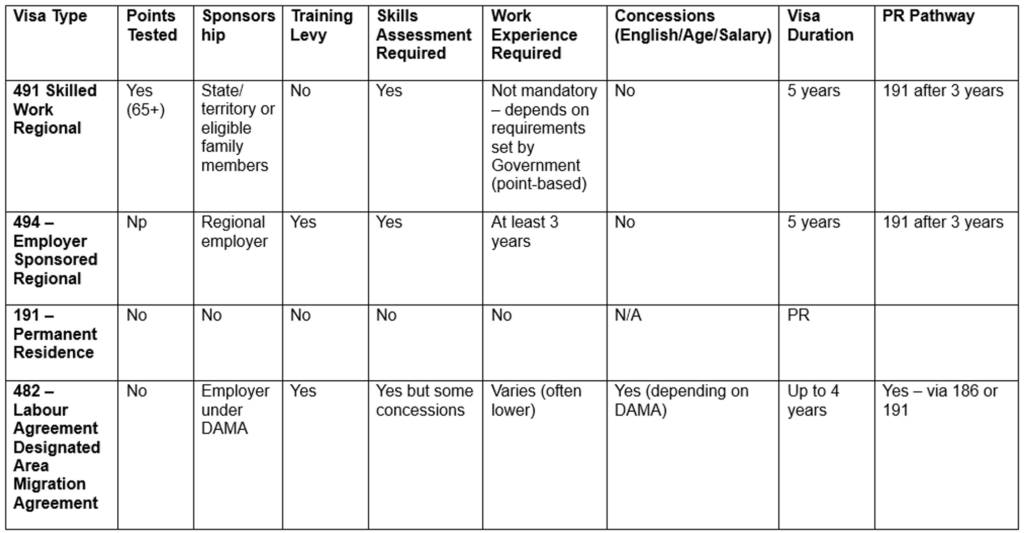
Regional visa types – key features 

There are specific visa types for regional Australia. They are only for people who will live and work in regional Australia.

Employers must have operations in the regions to be able to sponsor 494 visas.

482 visas are also available under a special Labour Agreement Stream known as Designated Area Migration Agreements. These are regionally negotiated Labour Agreements ‘owned’ by the local region and designed to help those regions attract workers in occupations with labour shortages either because of the location or because of a major infrastructure project draining local talent.


Quick comparison of regional to 482 visas 

In most cases 482 visas are preferred by our clients because they are a well-known path. They are generally the most suitable option given the needs of both the employer and employee. However, regional visas can provide some benefits over 482 visas and can be the most suitable option in some cases where a 482 is not available or not preferred.


Conditions on regional visa holders (and employers)                                                                                                                                                                

The usual sponsorship obligations apply to the 494 visa.

In addition, businesses must be lawfully operating in a designated regional area of Australia to be eligible to sponsor under this visa. ​

Visa holders are required to live, work, and study exclusively in designated regional areas for the duration of the visa, which is up to five years. Regional visa holders may live and work outside of a regional area for
•    holidays
•    work-related travel
•    work-related training

Visa holders must advise the Department within 14 days of any changes to the personal information or circumstances.


Relocating 

The Department understand that it may take a little time for someone to relocate to regional Austalia. Under policy the Department states:

  • If the person is already living and working in Australia (not in a regional area) then it is intended to allow a reasonable amount of time for the visa holder to move to a regional area. This will depend on individual circumstances, noting that it may take a number of months for a family to relocate.
  • Persons granted a Subclass 491 or Subclass 494 visa while residing outside Australia have more opportunity to make arrangements between being granted their visa and arriving in Australia. While remaining flexible in relation to individual circumstances, it would generally be reasonable to expect that they would establish living arrangements in a regional area within a month of arrival.


If you are interested in learning more about regional visa options, just contact your Ajuria team or email info@ajurialawyers.com

The post Regional Visa Options first appeared on Ajuria Lawyers – Leaders in Immigration.

Categories Australia

Understanding Resident Return Visas and Australian Citizenship

As an employer, it’s important to understand the key differences between Australian permanent residency and citizenship, particularly when it comes to employee travel rights and visa obligations.


Resident Return Visas (RRVs)

Permanent residency allows individuals to live and work in Australia indefinitely, but the travel facility tied to their visa is only valid for 5 years. After this period, if they have not been approved for citizenship yet, then to travel internationally, they will require a Resident Return Visa (RRV) to lawfully re-enter Australia as a permanent resident.

Employees intending to apply for permanent residence should seek advice about any tax implications for them.


What Employers Should Know:

  • Employees with permanent residency do not require ongoing sponsorship and have full work rights.
  • However, if they plan to travel overseas after the 5-year visa period, they must hold a valid RRV to re-enter Australia.
  • RRVs do not impact employment eligibility, but failure to obtain one can prevent re-entry, delaying return to work.


RRV Eligibility at a Glance:

  • 5-Year RRV: If the individual has lived in Australia for 2 out of the past 5 years as a permanent resident or citizen. The 2 years are calculated accumulatively and do not need to be consecutive.
  • 1-Year RRV: If they have strong personal, employment, or business ties of benefit to Australia but don’t meet the 2-year residence rule.
  • 3-Month RRV: In limited cases, for those who need to travel urgently and meet certain compassionate or compelling criteria.


Australian Citizenship

Australian citizenship provides the highest level of certainty for both employees and employers. It removes the need for travel-related visas entirely and unlocks full civic and legal rights.

Anyone considering applying for citizenship should seek advice about the impact on any other nationalities that they hold.


Citizenship Benefits for Employers:

  • No visa management or travel risks – citizens can leave and return to Australia freely.
  • Unrestricted work rights – no sponsorship or immigration monitoring required.
  • Access to roles restricted to citizens – such as some government or defence positions.


Key Citizenship Eligibility Requirements:

  • Must have been lawfully resident in Australia for 4 years, including:
    • At least 12 months as a permanent resident.
    • No more than 12 months in those 4 years spent overseas.
    • No more than 90 days in total in the final year spent overseas.
  • Must be of good character.
  • Must pass a citizenship test.
  • Must intend to remain in Australia or maintain close ties.


Recommendations for Employers:

  • Check travel plans of permanent resident staff and ensure they are aware of RRV requirements or promote information about this.
  • Encourage long-term employees to consider citizenship if eligible, to avoid re-entry risks.
  • Keep internal HR systems updated with visa expiry and travel facility dates, where appropriate.


Temporary vs Permanent Residence vs Citizenship

Feature Temporary Visa holder  Permanent Resident Citizen
Right to stay in Australia Limited to visa Indefinite Indefinite
Australian passport eligibility No  No Yes
Voting rights No  No Yes (compulsory)
Consular support overseas No  No Yes
Work rights Limited to visa Full work rights Full work rights
Access to government jobs Some restricted  Some restricted Full access
Purchase of property  Restricted 

Stamp duty may be higher

Unrestricted  Unrestricted 
International travel Limited to visa  Needs Resident Return Visa (RRV) Unlimited
Access to Medicare Sometimes generally need insurance  Yes Yes
Centrelink/social security No  Limited (subject to criteria) Full access
HECS-HELP for university No  Sometimes eligible Always eligible
Public school fees  Depends on state  No  No 
Military/jury duty No  Not required May be required
Deportation risk For breach of visa conditions or crimes  Possible for serious crimes Protected
Dual nationality NA  NA Allowed
Children born in Australia Same visa as parents  Citizens if born in Australia (not if born overseas) Automatically citizens


For further advice or assistance with RRVs, citizenship applications, or managing permanent residency in your workforce, please contact your Ajuria team or partner.


The post Understanding Resident Return Visas and Australian Citizenship first appeared on Ajuria Lawyers – Leaders in Immigration.

Categories Australia

Webinar Workshop – Earnings & Market Rates for Sponsored Visa Holders

There was so much interest in our last webinar on this topic that we have decided to run a follow-up 90 minute workshop that will allow us to discuss this topic in more detail and with practical examples.

The workshop will focus on those roles with earnings close to the Core Skills Income Threshold ($76,515 from 1 July 2025) and will look at examples including:

  • Australian equivalent workers
  • Awards and how they impact market salary
  • ‘Annualised’ salaries and additional hours
  • Rosters
  • Existing visa holders and what happens when the market salary or the SCIT increases

Thursday, 1 May 2025 – 3:00 PM AEST

REGISTER HERE


This workshop is exclusively for employer clients. To ensure your registration is confirmed, please provide your organisation name and your job title. Registrations without this information will be canceled. Please contact admin@ajurialawyers.com for further information.

The post Webinar Workshop – Earnings & Market Rates for Sponsored Visa Holders first appeared on Ajuria Lawyers – Leaders in Immigration.

Categories Australia

Key Insights from Day 1: 2025 Immigration Law Conference

Here are the key takeaways from Day 1 of the Law Council of Australia’s 2025 Immigration Law Conference in Canberra:

Subclass 482 Visa Trends

    • Significant Increase in Applications:
        • 7 Dec 2024 – 28 Feb 2025:
            • 7,664 applications finalised
            • 28,239 visa applications lodged
        • Breakdown by Stream:
            • Specialist Skills: 3,764 lodgements | 2,161 finalisations
            • Core Skills: 22,050 lodgements | 5,004 finalisations
            • Labour Agreement: 2,515 lodgements | 499 finalisations
      • Unexpected Growth: Despite the increase in minimum salary levels, visa lodgements rose rather than declined, defying the Department’s expectations.
      • High Volume of Lodgements: Over 3,000 applications per week, a 60%+ increase from last year’s program.
    • Labour market testing (LMT): plan to extend validity of LMT from 4 to 6 months likely to still come into effect – awaiting approval from Parliament and with the upcoming Federal Election, the government may move into ‘care taker mode’ and the legislation may not get through Parliament during this term.


Labour agreements

    • Changes announced last year for Labour Agreements not coming in any time soon- the Department has said this is a ‘tricky’ area and requires more time to develop.
    • Ongoing processing delays with the Labour Agreements acknowledged but no further feedback provided.


Processing Times & Backlog Reduction

    • Median Processing Times (Feb 2025):
        • Specialist Skills: 13 calendar days
        • Core Skills: 41 calendar days
        • Labour Agreement: 71 calendar days
        • Backlog Reduction for TSS Visas (pre-7 Dec 2024 lodgements):
        • 33,372 on-hand applications as of 28 Feb 2025 (down 35.3% from 51,566 on 6 Dec 2024).
        • Challenges Remain: Processing delays persist despite improvements. The Department are aware of the big discrepancy between applications lodged pre and post 7 December and are working to address this.


Department’s Actions to Improve Processing

    • IT System Enhancements in progress.
    • New Offshore Processing Centre in Hong Kong to help manage delays. This is the first time the processing of these visas has been moved offshore. The Department is looking at processing capacity in other offshore processing offices.


Compliance & Sponsorship Integrity

    • Stricter Enforcement of Accreditation & Sponsorship Obligations for accredited sponsors.


The post Key Insights from Day 1: 2025 Immigration Law Conference first appeared on Ajuria Lawyers – Leaders in Immigration.

Categories Australia

Webinar Workshop: Earnings & Market Rates for Sponsored Visa Holders

Thank you for your interest in our webinar Earnings & Market Rates for Sponsored Visa Holders hosted in March. We had over 250 attendees and a lot of interest and questions.

There was so much interest, in fact, that we have decided to run a follow-up workshop that will allow us to discuss this topic in more detail and with practical examples.The same panel will be there to answer your questions and provide valuable insights.

If you would like to attend, please register your interest to hold a spot.

The Panel


Thursday, 1 May 2025 – 3:00 PM AEST

REGISTER HERE

This workshop is exclusively for employer clients. To ensure your registration is confirmed, please provide your organisation name and your job title. Registrations without this information will be canceled. Please contact admin@ajurialawyers.com for further information.

The post Webinar Workshop: Earnings & Market Rates for Sponsored Visa Holders first appeared on Ajuria Lawyers – Leaders in Immigration.