Category Archives: Australia

Categories Australia

Changes to TSS and Regional 494 visa – 1 July 2024

Further to our newsletter earlier this week we have now received the new Regulations. However the policy around this has not yet been released.

Recap – what is changing
From 1 July 2024, TSS subclass 482 and Regional subclass 494 visa holders who cease employment with your business can stay in Australia and work for up to 180 days for any other employer in any occupation while they seek a new sponsor.

It also means you can employ TSS subclass 482 and Regional subclass 494 holders without having to transfer their sponsorship (nomination) before the commence work.

What has not changed?
All sponsorship obligations remain unchanged.

For employees ceasing employment, your business must still notify the cessation of employment of a sponsored worker within 28 days.

Your business is still obliged to pay the reasonable return travel costs of the sponsored workers and their family unless and until:

  • They have been nominated by another sponsor or granted a new visa; or
  • Have permanently left Australia and their work visa has been cancelled or expired.

Your business is still liable for up to $10,000 (less any travel costs paid) for the costs of locating and removing a sponsored worker or their family if they do not depart at the end of their visa. In practice we have never seen the Department enforce this provision.

Which visa holders does this apply to?  
The changes apply to all TSS and 494 visa holders from 1 July 2024. It does not matter when their visa was granted.

What does it mean for your business?

  1. You will need to continue to manage your sponsored employees in the same way but can expect that requests for travel costs might be made well after the sponsored worker has left your business.
  2. You will have the opportunity to hire TSS visa holders who have left their sponsored employment for up to 180 days in any position without the need to sponsor them. The 180 days will start on 1 July for ALL 494 and TSS visa holders, including ones who ceased employment before that date. Any time that a visa holder ceased working for their sponsor prior to 1 July 2024 will not count towards the 180 days.
  3. Sponsored employees will be able to work in between sponsorships for a total of no more than 365 days in the period of their visa.
  4. You will need to put thorough processes and checks in place to manage TSS and 494 visa holders who you have not yet sponsored to ensure they do not work for more than 180 days since their last day of employment with their previous sponsor and to ensure that you do not employ a sponsored visa holder outside of their occupation for more than 365 days.
  5. You should plan for some additional costs around managing this as it will be more difficult for us to provide a strategy for such workers, and we will need to charge for this work.

Can we get a refund of the SAF levy if a sponsored employee leaves?
Refunds of the Skilled Australia Fund (Training Levy) will still be extremely limited until the regulations change (the government is proposing to change the refund provisions, but we do not know when).

What happens if your former employee does not find a new sponsor within 180 days?
If they have not applied for another visa or found a new sponsor after 180 days, they will need to depart Australia or face possible cancellation of their visa. The business obligations continue as above.

Will this impact the permanent residence pathways for employees?
This is complex and will need to be worked out case-by-case but it should not change the current rules in most cases.

Under the current rules:
Under the 2-year sponsored pathway, as a general rule, the TSS visa holder needs to work in the position for which they were nominated. This means that their time starts again when they change sponsoring employers because they start in a new position. There is no change to this rule.

Upcoming possible changes:
However, another possible change flagged (we don’t know when) will allow sponsored workers to count periods of work for multiple sponsors (in the same occupation) when calculating the two years of sponsored employment before they can transition to permanent residence. There are no details yet about how this will be applied in cases where the person has not been sponsored in between roles (for up to 180 days) or where they may have worked in another occupation during this time under the new 365 day rule.

Our advice

  1. Continue to notify within 28 days of cessations of employment following the same process.
  2. Ensure internal systems continue to track visa expiries.
  3. Update internal systems to track any new employees holding a 494 and TSS visa that your business has not nominated to ensure that they are not employed for more than 180 days (this would be an offence) and not employed outside of their occupation for more than 365 days. Unfortunately, the Department will not provide us with data of when that employee ceased employment and VEVO at this stage does not have this data. Merely checking VEVO is not sufficient at this stage.
  4. If employing a visa holder before lodging a nomination (transfer) application, seek employment law advice regarding the type of contract to be issued (ie fixed or permanent).
  5. Continue to do nomination transfers as before to attract talent, for critical employees, and to avoid disruption and complications with permanent eligibility. Nomination requirements still remain the same.

As always we are here to assist and you should contact your Ajuria advisor for more information.

The post Changes to TSS and Regional 494 visa – 1 July 2024 first appeared on Ajuria Lawyers – Leaders in Immigration.

Categories Australia

Changes to work visa conditions for TSS and Regional 494 employees

From 1 July 2024, TSS subclass 482 and Regional subclass 494 visa holders who cease employment with their sponsoring employer will be able to work for up to 180 days for any employer in any occupation while they seek a new sponsor. If they have not found a new sponsor after 180 days, they will need to depart Australia or face possible cancellation of their visa. Sponsored employees will be able to work in between sponsorships for a total of no more than 365 days in the period of their visa.

Sponsoring employers will still be required to notify of changes in circumstances (including changes in occupation) and cessations of employment within 28 days.

The changes will apply to existing visa holders, as well as those granted a visa on or after 1 July 2024. Any periods a visa holder stopped working for their sponsor before 1 July 2024 will not count towards the new time periods outlined above and those employees will have 180 days from 1 July to find a new sponsor.

The changes will make it easier for employees to move between sponsors. It will also open opportunities for employers to hire sponsored workers in any occupations for up to six months without the need to sponsor them.

Employers who employ a TSS or regional visa holder will need to carefully track the 180 days and the expiry date of the existing visa carefully to ensure that the employee is not employed beyond 180 days unless:

  • A new nomination has been approved.
  • A new nomination and a new visa has been lodged and a bridging visa granted if the current visa is due to expire within the 180 days (or before the new application is approved).

These changes are part of a package of expected reforms to reduce the reliance of sponsored employees on a particular sponsor and so lessen the chance of worker exploitation. Other changes expected to be announced shortly include allowing sponsored workers to count periods of work for multiple sponsors when calculating the two years of sponsored employment before they can transition to permanent residence and allow sponsors to spread the payment of the SAF levy over the life of the employment

As these changes take effect, employers may need to consider their current policies in relation to the payment and recovery of visa costs and the period of agreed sponsorship for new employees as these changes could mean that sponsored employees become more mobile and less likely to work for the same employer for the full period of their sponsorship.

As always we are here to assist and you should contact your Ajuria advisor for more information.

The post Changes to work visa conditions for TSS and Regional 494 employees first appeared on Ajuria Lawyers – Leaders in Immigration.

Categories Australia

Increase in the Temporary Skilled Migration Income Threshold (TSMIT) & other 1 July reminders

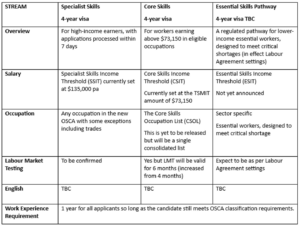
From 1 July 2024, the Temporary Skilled Migration Income Threshold (TSMIT) will increase from $70,000 to $73,150. New nomination applications from this date will need to meet the new TSMIT of $73,150 or the annual market salary rate, whichever is higher.

This change will not affect existing visa holders and nominations lodged before 1 July 2024. However existing TSS visa holders will need to be reviewed and earnings increased to meet the market rate.

Labour Market Testing
Labour Market Testing for nominations to be submitted after 1 July will need to be for at least this new TSMIT amount.

Increase of visa application lodgement fees
A reminder that Immigration fees are likely to increase on 1 July 2024 as they generally do each year. Fees generally increase by CPI but we will not know the exact amount until closer to 1 July.
Upcoming lodgements for permanent residence and temporary visas should be made pre-1 July to reduce cost increases.

Increase of FWHIT
The Fair Work High Income Threshold (FWHIT) is currently $167,500 but this figure will also be adjusted on 1 July.

Jobs & Skills Australia Consultation on the Core Skills Occupations List
A reminder the Jobs and Skills Australia Core Skills Occupations List (CSOL) Consultation is still open. Submissions can be lodged until 5:00pm AEST on Friday, 31 May 2024.

For further information please contact your Ajuria advisor.

The post Increase in the Temporary Skilled Migration Income Threshold (TSMIT) & other 1 July reminders first appeared on Ajuria Lawyers – Leaders in Immigration.

Categories Australia

New Visa for UK Citizens: Innovation & Early Careers Skill Exchange Pilot

As we get close to the first anniversary of the Australia-United Kingdom Free Trade Agreement (A-UKFTA) the Australian government is piloting a new Australian visa program for UK nationals. The Innovation and Early Careers Skills Exchange Pilot (IECSEP) provides new opportunities for UK citizens to come to Australia for 1 to 3 years. This pilot is currently open and will run until 30 June 2025 with 2000 spots being available from 1 July.

There are two streams under IECSEP:

  • the Early Careers Skills stream, which will allow participants to undertake a short-term placement, secondment, or intra-corporate transfer for up to one year in Australia.
  • the Innovation stream, which will allow highly skilled and experienced participants, with a demonstrated contribution to innovation, to undertake opportunities for up to three years in Australia.

All IECSEP applicants must be able to demonstrate UK citizenship, and that they have adequate financial means to support themselves for the duration of their stay in Australia ($5000 plus the fare to where the applicant is going to after Australia).

Early Careers Skills Stream
To be eligible for the Early Careers stream applicants must:

  • be aged between 21 and 45 (inclusive) at the time of application
  • hold tertiary qualifications
  • have worked for at least 3 months in their current role, and the prospective employment in Australia must be relevant to the applicant’s field of work in their current role
  • have prospective employment in Australia in an occupation defined at the ANZSCO Skill Levels 1, 2 or 3

The government has already announced that from 23 November 2024, it will reduce the work experience requirement for the Temporary Skill Shortage (subclass 482) visa from two years to one year for all applicants. This stream of the program will be attractive for those under 45 looking to get 1 year of experience in Australia before potentially moving to a TSS visa.

Innovation Stream
To be eligible for the Innovation stream applicants must:

  • have a demonstrated contribution to innovation
  • be highly skilled
  • be highly experienced
  • have prospective employment in Australia in an occupation defined at the ANZSCO Skill Level 1

For IECSEP, innovation is broadly defined as the development or implementation of a new or improved product, process, or organisational method, or combination thereof. IECSEP recognises that innovation drives efficiency and productivity growth in all industries, and that innovators are working across a broad and diverse range of occupations. Innovation Stream applications are welcome from applicants working across all sectors, including service-based industries, and academia.

Process
The process is 2 steps:

  1. An endorsement letter is obtained from, the Department of Foreign Affairs & Trade – this will take 7 days under the Early Careers Stream.
  2. An application is then lodged with theDepartment of Home Affairs for a Temporary Work (International Relations) subclass 403 visa Government Agreement stream.

Business requirements
There is no sponsorship on the part of the business and no evidence of Labour Market Testing is required. Unlike the TSS work visa, there is also no minimum TSMIT requirement although the National Employment Standards must be complied with.  With no Training Levy payable, the visa lodgement fee is also a lot lower at $355.

For further information on this visa, please contact your Ajuria Lawyers advisor.

The post New Visa for UK Citizens: Innovation & Early Careers Skill Exchange Pilot first appeared on Ajuria Lawyers – Leaders in Immigration.

Categories Australia

Australian Federal Budget 2024-2025 – Immigration Impacts

Australia’s federal government has handed down its 2024-2025 budget with the following announcements related to the migration portfolio:

Changes to the TSS visa

  • From 23 November 2024, the Government will reduce the work experience requirement for the Temporary Skill Shortage (subclass 482) visa from two years to one year for all applicants.

Resources for visa processing

  • Increased staffing levels and resources to remediate the impacts of under-resourcing and reduce backlogs across multiple government departments including the Department of Home Affairs to improve visa processing capabilities and decrease wait times.

Migration Planning Levels

  • The government will allocate 185,000 places for the next financial year’s permanent migration program. Of this, 132,200 of those places will be allocated to the Skilled Stream to “help address Australia’s long-term skill needs”.
  • Net overseas migration is forecast to be 260,000. The 2023-24 number is expected to come in at 375,000.

New ballot programs

  • From FY2024-25, a $25 ballot for working and holiday visas will also be introduced for people coming from China, Vietnam and India. This ballot will help to cut down processing times for visa applications and help to manage demand.
  • From 1 November 2024, there will be 3,000 visa places for Indian graduates and early-career professionals in certain sectors to live and work in Australia for up to two years. Indian nationals seeking to apply will pay $25 to enter a ballot, and then pay $365 for the visa if they are successful.

Related to Australia’s new partnership with India, the government has also extended the maximum validity of the Visitor visa (subclass 600) Business Visitor stream for Indian nationals from up to three years to up to five years.

Focus on Employer Sponsored Activity  

  • $100.0 million to support Australian Border Force operations, immigration compliance activities and sustainment of critical systems supporting those operations and services.
  • $1.9 million to conduct a data-matching pilot between the Department of Home Affairs and the Australian Taxation Office of income and employment data to investigate underpayment and exploitation of migrant workers.

Global Talent and Business Innovation

  • From late 2024, the government will implement a new National Innovation visa, replacing the current Global Talent visa (subclass 858), to target exceptionally talented migrants who will drive growth in sectors of national importance.
  • From September 2024 and as forecast by the government the Business Innovation and Investment visa program (BIIP) will be scrapped. Refunds for visa application charges paid will be available for those who wish to withdraw their application.

Students and the university sector

  • The number of places for international students will now be capped, although the number has not yet been determined. Previously this was uncapped.
  • Education providers will be required to limit the maximum number of new international student enrolments each year. If education providers want international students above that limit, they will be required to build new purpose-built student accommodation to benefit both international and domestic students.
  • Higher education providers under investigation for serious regulation breaches will be banned from recruiting students from overseas, and newly registered institutions will be required to prove a demonstrated track record of quality course delivery for domestic students before allowing foreign enrolments.

As always you should contact your Ajuria team for more information and assistance.

The post Australian Federal Budget 2024-2025 – Immigration Impacts first appeared on Ajuria Lawyers – Leaders in Immigration.

Categories Australia

Visa Processing Update – Dealing with delays

A few months after the government announced its intention to reduce migration numbers, we have observed noticeable delays across various visa categories due to shifts in government policies. Here’s a summary of the current landscape:

TSS Work Visas: Officially the Government has updated its processing times to:

  • 50% are processed in 23 days
  • 90% are processed in 3 months

In practice, we are seeing variations from a few days to a month and even longer (even for accredited sponsors). The Department is very clear that no escalation requests even in urgent matters are to be considered if within the above published processing times.  Any escalation requests are seen as clogging the system.

Permanent Residence: Very limited permanent residence visa grants. Whilst business nominations are being approved, visa grants are being delayed until post 1 July because of the Department’s annual quotas which will reset in the new financial year.

400 Visas: These are processed by the offshore Embassy/High Commission and processing is inconsistent depending on the location of the processing office. We are not seeing a change in processing times which continue to vary from a few days to weeks.

Medical examination delays: Ongoing delays in obtaining bookings for medical examinations in Australia leading to delays with grants. Visas cannot be granted until medicals are done.
It is more important than ever to lodge applications as soon as possible to manage business expectations noting the 1 July likely increase of fees and changes to the TSMIT as per our previous update.

As we lead up to the Australian Federal Budget next week we will keep our clients updated with further developments.

The post Visa Processing Update – Dealing with delays first appeared on Ajuria Lawyers – Leaders in Immigration.

Categories Australia

Preparing For Post 1 July TSS Lodgements & Update On Processing Times

As the new financial year fast approaches businesses must factor in changes that affect TSS application lodgements:

Increase of TSMIT
As flagged by the Migration Strategy, the Temporary Skilled Migration Income Threshold (TSMIT), currently set at $70,000 per annum, will increase every 1 July going forward indexed to the Wage Price Index. This is estimated to fall between 4.2% and 4.5%. Calculations would land the new TSMIT post 1 July 2024 at between $73,010 and $73,150.

  • This will mean the guaranteed earnings (not including superannuation) for 38 hours for any new TSS nomination lodged under the standard TSS program after 1 July 2024, will need to be more than this amount and at least market rate.
  • Existing TSS visa holders will need to be reviewed and earnings increased to meet the market rate.
  • Labour Market Testing for nominations to be submitted after 1 July will need to be for at least this amount.

Increase of visa application lodgement fees
Immigration fees will increase on 1 July 2024 as they generally do each year. Fees generally increase by CPI but we will not know the exact amount until closer to 1 July.

Upcoming lodgments for permanent residence and temporary visas should be made pre-1 July to reduce cost increases.

Increase of FWHIT
The Fair Work High Income Threshold (FWHIT) is currently $167,500 but this figure will also adjusted on 1 July.

Jobs & Skills Australia Consultation on the Core Skills Occupations List
A reminder the Jobs and Skills Australia Core Skills Occupations List (CSOL) Consultation is now open. The survey is open until Friday, 10 May 2024, and submissions can be lodged until 5:00pm AEST on Friday, 31 May 2024. Business may opt to do either or both.

Update on current processing times
We are now seeing:

  • Limited permanent residence visa grants. Whilst business nominations are being approved, visa grants are being delayed until post 1 July because of the Department’s annual quotas
  • Delay on TSS visa processing with greater inconsistency – varying from a few days to months (even for accredited sponsors)
  • Ongoing delays in obtaining bookings for medical examinations in Australia leading to delays with grants.

Upcoming Federal Budget
The Treasurer will deliver the 2024–25 Federal Budget on Tuesday, 14 May 2024. The Federal Budget normally has significant announcements affecting the immigration portfolio we will send an update shortly after the announcements are made.

Our office held a webinar yesterday and a recording can be found here.

For more information or to discuss these upcoming changes please contact your Ajuria Lawyers advisor.

The post Preparing For Post 1 July TSS Lodgements & Update On Processing Times first appeared on Ajuria Lawyers – Leaders in Immigration.

Categories Australia

Webinar Recording – What’s to come & how to plan for Immigration changes

Our webinar is designed to help sponsors determine the level of impact and plan for it as we come closer to the end of the financial year.

In this webinar, we covered:

  • Impacted occupations on the CSOL Consultation and Labour Agreements
  • 1 July Increases – TSMIT, Immigration fees, super and FWHIT
  • Budgeting for Immigration expenditure in the new Australian financial year
  • Reminder on change of positions/promotions
  • Compliance activity Increase

The post Webinar Recording – What’s to come & how to plan for Immigration changes first appeared on Ajuria Lawyers – Leaders in Immigration.

Categories Australia

Webinar: What’s to come & how to plan for Immigration changes

The government is currently proposing major reforms to the Australian visa program. Join our webinar designed to help sponsors determine the level of impact and plan for it as we come closer to the end of the financial year.
We will cover:

  • Impacted occupations on the CSOL Consultation and Labour Agreements
  • 1 July Increases – TSMIT, Immigration fees, super and FWHIT
  • Budgeting for Immigration expenditure in the new Australian financial year
  • Reminder on change of positions/promotions
  • Compliance activity Increase
Thursday, 2 May 2024 – 11am AEST
REGISTER HERE NOW

Presenters

The post Webinar: What’s to come & how to plan for Immigration changes first appeared on Ajuria Lawyers – Leaders in Immigration.

Categories Australia

Webinar Invitation – What’s to come & how to plan for Immigration changes

The government is currently proposing major reforms to the Australian visa program. Join our webinar designed to help sponsors determine the level of impact and plan for it as we come closer to the end of the financial year.

We will cover:

  • Impacted occupations on the CSOL Consultation and Labour Agreements
  • 1 July Increases – TSMIT, Immigration fees, super and FWHIT
  • Budgeting for Immigration expenditure in the new Australian financial year
  • Reminder on change of positions/promotions
  • Compliance activity Increase

WEBINAR

Thursday, 2 May 2024 – 11am AEST

Presenters

Navpreet Kanwar & Karen Lo


The post Webinar Invitation – What’s to come & how to plan for Immigration changes first appeared on Ajuria Lawyers – Leaders in Immigration.